

Persuasion Tip: Be More Expressive
Same words. Same pitch. Same argument. One delivers. One falls flat. The difference is not content. It is your expressiveness.
Research shows that people are up to 36% more willing to buy from salespeople who are more expressive, combining an energetic tone of voice, deliberate gesture and physical presence that signals genuine conviction.
The finding was reviewed by behavioral scientist Thomas McKinlay in his newsletter Science Says (May 2026). Thirty-six percent. Not from a better pitch. From a more expressive delivery of the same pitch.
What expressiveness actually means
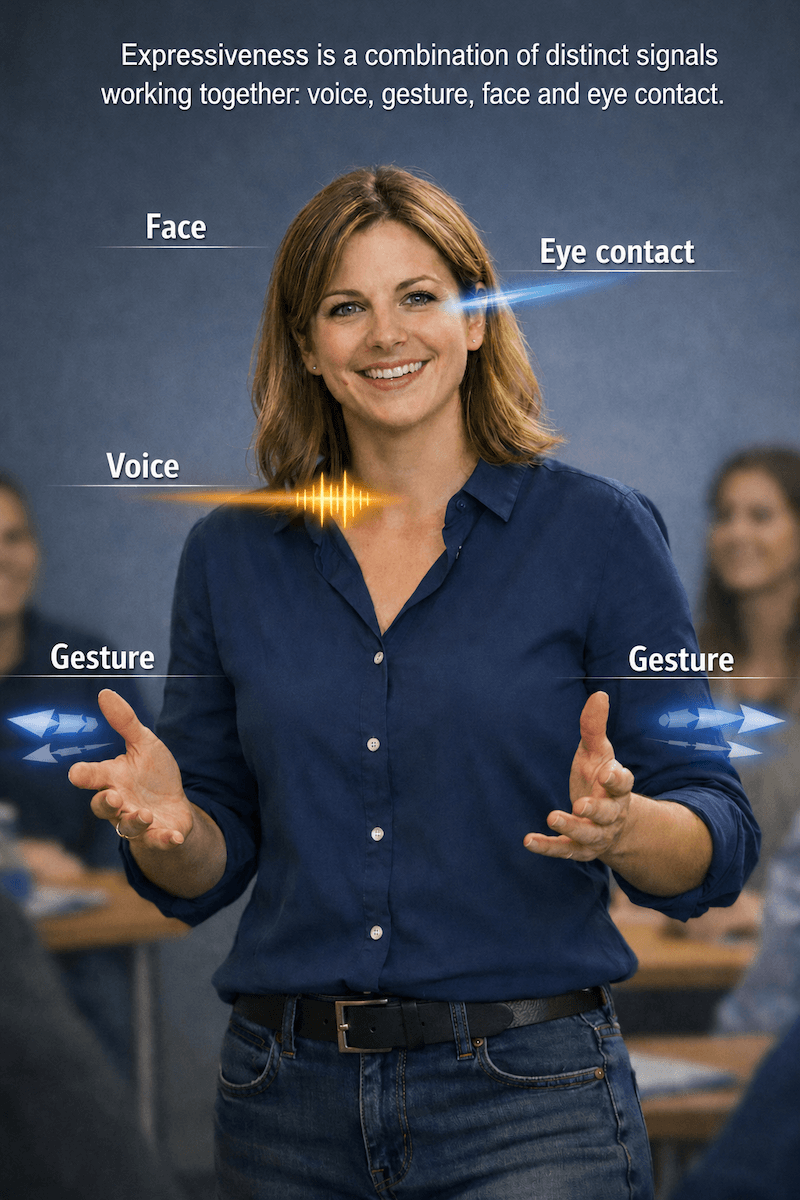
Expressiveness is not one thing. It is a combination of four distinct signals working together:
- Voice: variation in pitch, volume, pace and tone that prevents flat, monotone delivery.
- Gesture: dynamic hand movements and posture shifts that give your words physical weight.
- Face: authentic expression that signals warmth, urgency or conviction.
- Eye contact: intentional gaze that builds a direct psychological connection with your listener.
When all four align with your message, audiences read you as credible and engaged.
The science behind the signal
There is no shortage of research confirming that expressive delivery shapes how speakers are perceived. One of the most striking studies comes from Stephen Ceci at Cornell University, and it shows just how far that effect reaches.
Ceci taught the same course to two consecutive student groups, with identical content, textbook, syllabus and exam questions. The only difference was delivery. Between the two semesters he worked with a media consultant to develop more expressive vocal tone, pitch modulation and deliberate gesture. Then he taught the same course again.
The results were striking. Compared to the first group, the expressive group rated:
- His knowledge as significantly higher.
- His organization as significantly better.
- His grading policy as significantly fairer.
- The textbook itself as higher quality.
- Their own learning as substantially greater.
Expressiveness had not changed the content. It had changed how everything around it was perceived.
What low expressiveness costs you
A flat delivery does not just fail to persuade. It actively undermines your message. When your words say one thing and your body says nothing at all, people resolve the contradiction in favor of the body. The content gets discounted.
This is why perfectly structured arguments can fall completely flat. The logic was there. The energy was not. And the audience, consciously or not, concluded that even you did not quite believe it.
How to use it
- ✕ Delivering your key point in the same flat tone you use for everything else.
- ✓ Letting your voice, pace and physicality shift when you arrive at the moment that matters most.
- ✕ Standing still with your hands at your sides to “look professional.”
- ✓ Using gesture to give your ideas physical weight and direction.
- ✕ Treating expressiveness as something that happens naturally, or not at all.
- ✓ Rehearsing your delivery with as much care as you give your content.
A practical starting point: record yourself once. Not to critique your words. To watch what your body is doing while you say them. Most people are surprised by how little signal they are actually sending.
Expressiveness is not a personality type
You do not need to be naturally extroverted or theatrical. Expressiveness is a skill, not a trait. It can be developed. The goal is not to perform more. It is to let what you already believe come through more fully in the way you communicate it.
Be more expressive. Not to be louder. To be heard.