

Persuasion Tip: The Illusory Truth Effect
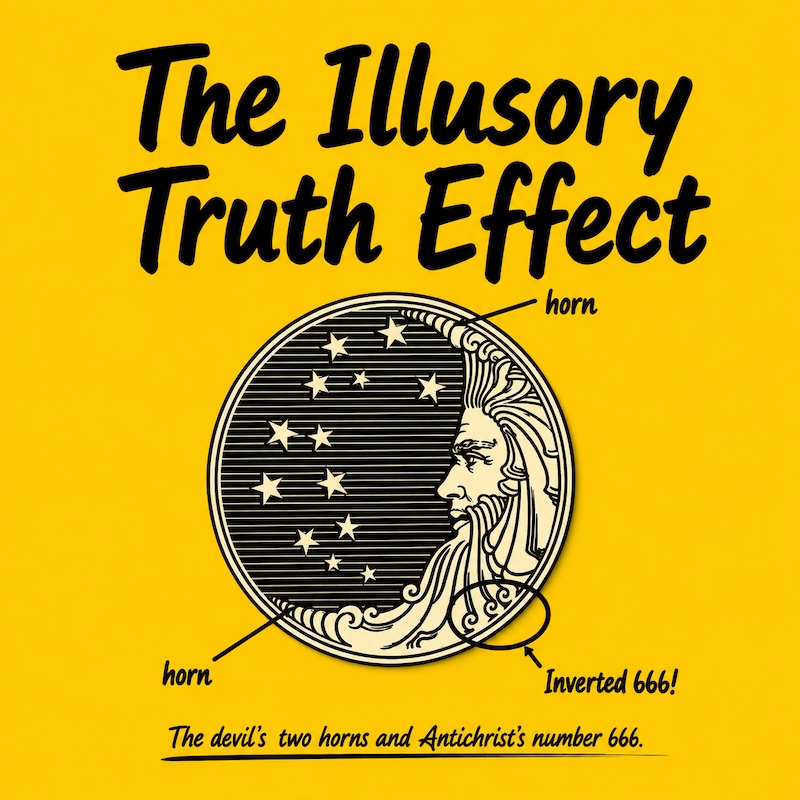
In 1980, a rumor started that Procter & Gamble’s moon and stars logo was a satanic symbol. The company had no connection to the occult.
But the claim spread. By word of mouth, then by photocopied flyers, then by retellings of a talk show confession that never actually happened. It was repeated so often that P&G eventually removed the logo from its products in 1985.
No new evidence ever surfaced. The claim simply got said enough times to feel true.
What the effect actually does
That is the illusory truth effect at work. Repetition makes a claim feel more believable, whether the claim is true or false.
The effect is not absolute, though. Claims that contradict something you know with confidence, a fact you would bet your own name on, resist it more than claims sitting in the grey area of things you are not sure about.
Why this matters for you
For a communicator, this cuts two ways.
Used with care, repetition helps a real message land and stick with your audience. Used carelessly, or used on you, it can make a false one feel more solid than the evidence supports.
The science
Psychologists Lynn Hasher, David Goldstein and Thomas Toppino ran the original study in 1977.
Participants rated a set of trivia statements as true or false across several sessions. Statements repeated across sessions were rated as more truthful than new ones, regardless of whether they were actually true.
A follow up, twenty years later
A 2015 study went further. Lisa Fazio, Nadia Brashier, Keith Payne and Elizabeth Marsh found that people who already knew the correct answer still rated a repeated false statement as more believable than a new one, in most cases.
They called this “knowledge neglect.” Knowing better reduced the effect somewhat. It did not eliminate it.
The mechanism underneath
Both findings point to the same explanation: processing fluency.
Repeated information is easier for the brain to process, and the brain reads that ease as a signal of truth. It is a shortcut, not a reasoned check.
It shows up in politics too
The tactic is not confined to marketing.
After the 2020 US presidential election, the claim that the result was “rigged” was repeated across rallies, broadcasts and social media. More than 60 lawsuits challenged the outcome, and courts dismissed the large majority, many explicitly for lack of evidence.
The claim kept circulating anyway. A substantial share of Republican voters came to believe it, independent of what the court record showed.
That gap, between what the evidence showed and what people ended up believing, is the illusory truth effect operating at national scale. The tool itself is neutral. It does not check whether a message is true, only how often it gets repeated.
Using it responsibly
Repeat your key message but change its shape each time rather than repeating the exact sentence.
- × “As I said earlier, our approach saves time.”
- ✓ “Saving time is not a nice to have. It is the reason clients come back.”
When correcting a myth, do not repeat the false version even to deny it. Lead with the truth instead.
- × “It is not true that our product is difficult to use.”
- ✓ “Our product is built for a five-minute setup.”
Catching it in yourself
Ask why a claim feels true. If the honest answer is “I have heard it a lot,” that is familiarity, not evidence.
Notice when you cannot trace a fact back to where you first learned it. That blank spot is worth a pause before you repeat the claim yourself.
Treat insistence as a prompt to check, not a reason to believe.
Repeat with intention, not by accident
Familiarity is not evidence, though our brains often treat it that way. Repeat what is true with intention. Stay alert to repetition doing the work that evidence should be doing instead, whether you are the one repeating it or the one hearing it.
Familiarity is not evidence, though our brains often treat it that way.