

“If you think you can’t, change your mind.” —Denis Morton

Your personal brand impact starts in your head, before it ever shows up online
“I don’t need personal branding. My work speaks for itself.”
That’s what many professionals and business owners say, but it’s rarely the real reason. The deeper truth? Most people avoid it because they don’t think they’re ready, worthy or clear on what they’d even say.
If you’re not getting the recognition, opportunities or clients you want, chances are your mindset, not your résumé or website, is the real blocker.
That’s why personal branding matters
It’s not just for influencers or celebrities. It’s for anyone who wants to stand out and succeed. Whether you’re climbing the corporate ladder or running your own business, how clearly you see your value, and how confidently you present it, makes all the difference.
Professionals who take time to define their brand strategy — how they show up, communicate their worth and build their network — are more likely to unlock opportunities and move forward faster. The same goes for business owners and freelancers: the more clearly you can express your value, the more likely others are to see and trust it.
As a coach, I’ve worked with many professionals and business owners at different stages of their journey. What I’ve consistently seen is that personal branding isn’t just a skill set challenge. It’s a mindset shift challenge. There are three mindset stages people tend to go through in their personal brand evolution, and they mirror how they start seeing themselves, and showing up differently because of it.
Let’s break them down.
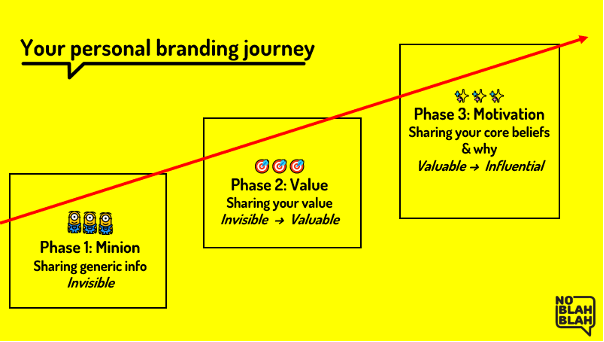
Stage 1: The minion phase
You can’t stand out if you still think like a minion.
You’ve just started a job or launched a business. Your focus? Fit in, learn the ropes and do things right. But you’re so busy doing all that, you forget one crucial thing: no can see you.
You introduce yourself by title—“I’m a marketing coordinator” or “I run a design business.” It’s accurate, but forgettable. It doesn’t spark interest or tell anyone why they should pay attention to you.
In this phase, you’re playing it safe, often without realizing it, and keeping yourself invsible as a result.
Mindset Shift #1: Stop presenting yourself as a generic role. Start seeing yourself as someone with a point of view, value and a voice worth sharing.
Stage 2: The value phase
Get clear on what you bring to the table
Eventually, something clicks.
You’re being passed over for opportunities. Or your business isn’t attracting the right clients. You realize great work alone isn’t enough. People don’t always see your value.
So you start speaking differently. Not bragging, but highlighting impact.
You stop saying, “I’m a project manager,” and start saying, “I help teams deliver complex projects without burnout.”
You move from listing roles or services to showing the real problems you solve for real people.
Mindset Shift #2: You take ownership of your story. You stop waiting for others to notice your work and start shining a light on it yourself.
You start getting intentional: showing up, speaking up, sharing wins and aligning your message with your value.
Stage 3: The motivation phase
Step into who you truly are
This final stage is the most powerful… and the most vulnerable.
You’ve built up some traction. People know what you do. You’ve carved out a niche. Now, the next leap comes from letting people in.
You let go of the polished, “perfect” version and start sharing what truly drives you: your values, purpose and the change you stand for.
This is how you attract your tribe, people who connect with you, not just your work.
Maybe you share a failure, speak up on a tough issue or show how your values shape what you do.
Mindset Shift #3: You realize that your personal brand isn’t about a perfect image, it’s an expression of what you care about and what you’ve learned on your journey.
This stage is magnetic. When you share your truth, the right people lean in—and the wrong ones filter out. That’s exactly what should happen.
How to shift your mindset to grow your visibility and influence
Mindset isn’t just about confidence—it’s about clarity, ownership and perspective. Here are two real-world examples of professionals who grew their visibility by changing how they saw themselves.
The first is a senior technical professional I coached. For years, he saw himself as a behind-the-scenes executor. Others viewed him as a reliable project manager, but in his mind, he was a strategic thinker. The disconnect held him back. Once he paused to reflect on his growth and recognized the value he brought at a strategic level, his next steps were clear. To move forward he needed to start introducing himself differently, share more advisory insights and advice at meetings and actively position himself for higher-impact roles.
The second is a team leader in a service support group with 20 years of experience. After having her first child, she began to reevaluate what really mattered to her, both at work and at home. She realized she no longer wanted to blend in or just “get the job done.” She wanted her work to reflect her values. That clarity gave her the confidence to speak up about the kind of leadership she believed in and advocate for her deeper purpose within her organization.
Both of these shifts didn’t start with external strategies, they started with internal decisions: to see themselves differently, to let go of limiting beliefs and to take ownership of their voice.
Bottom line?
Your brand begins in your mind. And the moment you start changing how you think about yourself, you change how others see you.
The world doesn’t need more polished bios. It needs more real people showing up boldly with purpose, value and belief.
What do you think you can’t do?
Start with changing your mindset and everything else will follow.
Contact
Are you interested in “If you think you can’t, change your mind.” —Denis Morton? Please contact us.