

Noblahblah ❤️ Scientists and Technical Experts
You’ve got the project definition, data and product specs right. The launch deadline is set.
Now comes the big challenge. How do you keep everyone on board, from the project team to external partners to management? All under high time, cost and quality pressure?
That part wasn’t on the syllabus at university.
Here’s where communication and persuasion skills come in. So you do a LinkedIn search. Presentation training companies are everywhere. Public speaker coaches are waiting on every corner. (Exaggeration! Mostly!)
But there’s one company that’s focused on communication and persuasion skills for scientists, technical experts and leaders in technology companies.
Noblahblah!
We’re even the official speaker coaching partner of Bits&Chips, the annual system architecture event in Eindhoven, the high-tech heart of the Netherlands.
So how can that help you run your projects and launch your products?
Nobody is more allergic to blah blah blah
Scientists and technical experts are trained in the scientific method. They build conclusions from data, theory and evidence, not flowery language and vague promises. Nobody is more allergic to blah blah blah.
We know!
Born between the laboratory and the corporate meeting room
High-tech companies are under constant pressure to find solutions that don’t exist, to apply them in new products and get them to market. The people working in these processes need to share their ideas concisely and convincingly.
Noblahblah was born in this environment, between the laboratories and meeting rooms of Canon Production Printing (CPP), one of the top R&D investors in the Netherlands.
It’s there that our co-founder Howard Lettinga, then working in Corporate Communications, developed a training course to help his colleagues share ideas with each other.
Today, more than a decade later, that training has evolved into our Noblahblah Present to Persuade training. The core tool is our Funnel Technique.
The Physics of the Funnel
There are many presentation and story templates in the world. But at Noblahblah, we love the Funnel Technique. It’s based on a writing and composition technique developed by Sheridan Baker, Professor Emeritus of English Language and Literature at the University of Michigan.
We love the Funnel Technique for three main reasons. It forces you to:
- Focus on your audience… immediately
- State your core idea in a clear way that’s easy for the audience to remember
- Justify that idea with the tools of rhetoric, the art of persuasive writing and speaking
We also love how the Noblahblah Funnel Technique echoes something scientists and tech experts love: the laws of physics, engineering and science.
Here are the five steps of the funnel at work.
Step 1: Get something fluid (like the audience’s attention) into the funnel
From a physics perspective, what does a funnel do? In our training sessions, our coaches have asked that question to hundreds of people.
The answer? A funnel gets something fluid to the place where you want it to be. One clever student even said the funnel slows the fluid down.
Precisely! That’s what you as a speaker do with the Funnel Technique. You get the attention of the audience to the place where you want it to be.
You do that with a description of the audience’s pain or your vision. (Such as the opening of this article.) With a quotation, a statistic or a story. Or any other technique, limited only by your own creativity.
You direct their attention to Step 2: Your idea worth spreading. (Because you can only share your idea after you have their attention, right?)
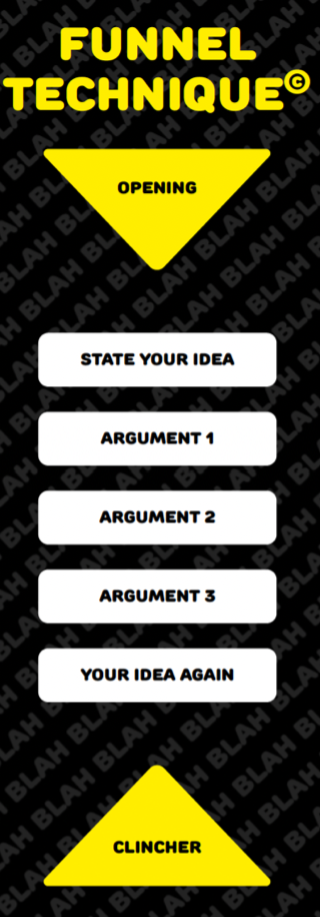
Step 2: State your idea (worth spreading) with precision
“The single biggest problem in communication is the illusion that it has taken place,” according to a clever aphorism. That’s why Step 2 in the Funnel Technique is to state your idea with clarity and precision. (Scientists and technical experts love clarity and precision, right?)
All our Noblahblah coaches have worked not only with scientists, tech experts and leaders in tech companies, but also with TEDx speakers. The main rule of a TEDx talk is to have a clear “idea worth spreading”.
That’s the driving idea behind Step 2: State your idea. Preferably in 4 to 7 words. In plain language. Short, sharp and in a way that’s easy for the audience to repeat. Such as…
- Know your “Why”
- Use recyclable materials
- Disagree in the meeting, not afterwards
- Hire a product manager
- Noblahblah ❤️ Scientists and Technical Experts
If you can state and repeat your idea clearly, so can your audience.
Step 3: Support your idea with logic, credibility (and a bit of storytelling magic)
An idea needs explanation and justification. Here again, the Funnel Technique demands solid engineering.
You use logic, rationale and facts to help prove your case. You use your own credibility and authoritative reference sources to strengthen your persuasive framework. You use stories and emotion to address the mindset of the audience and help make them care.
These are the logos, ethos and pathos that Aristotle talks about in his treatise on Rhetoric, the art of persuasive speaking and writing. It’s a structure for persuasion that has been standing for more than 2300 years. That’s solid engineering.
For example, in this article:
- Logos: The three reasons to ❤️ the Funnel Technique above
- Pathos: The storytelling in the opening about the life of a project lead
- Ethos: The story of how Howard developed the core training in Canon Production Printing
Step 4: Restate your idea (just like a repeatable experiment and result)
In science, one successful experiment is interesting. A repeatable result starts to get convincing. The same applies to communicating your idea, and that’s Step 4.
If your audience remembers only one thing, it should be the one thing you most want them to remember. So after guiding them through the logic, credibility and emotion, return to your central idea. State it again clearly (and with the discipline of not introducing 17 exciting new variables at the last minute).
If your conclusion matches your original proposition, congratulations. Your argument has survived the process. Can your audience repeat the idea? Peer review passed!
Noblahblah ❤️ Scientists and Technical Experts!
Step 5: Create momentum with the opening. Land your idea with the ending
To emphasize the importance of a strong ending, we always share this thought.
Hollywood and Bollywood spend billions each year making films. Then when the credits roll, audiences reduce all that investment, talent and CGI computer generated imagery to one simple verdict. Great ending, great film! Rubbish ending, rubbish film!
Presentations obey the same inconvenient law. You can generate plenty of intellectual energy, build magnificent momentum and fire off supporting data, but the ending is where it all lands.
Is there a law of physics at work there? Not really. But there is the law of logic and memory called the recency effect: the last thing you read or hear is highly memorable. Read all about it in this Noblahblah Persuasion tip.
So here’s our clincher cocktail for this article
- Read a bit of proof from scientist Liza Cornet, a Fan of the Funnel
- Get the Funnel for all that presenting you’re doing
- Attend Xaviera Reynhout’s breakout session at Bits&Chips 2026 for a broad view of product management… with a touch of no blah blah
- And allow us to end on the big “Why”
1. A bit of scientific proof
Over the years, the Funnel Technique has generated a small group of fans, such as Liza Cornet. She’s a neuropsychologist with a PhD in neurocriminology. Since 2021, she’s given hundreds of workshops and lectures, including a TEDx Talk. Our trainer Howard Lettinga was her coach.
“Howard introduced me to the Funnel Technique, a technique for structuring a story with a clear opening, supporting arguments and a conclusion. That structure gave me the guidance I needed to get my ideas down on paper.”
2. Scientists, tech experts and leaders are presenting all the time
They present their ideas in meetings, in one-on-ones, at the lunch table and the coffee machine. That’s the communication that greases the wheels of progress and innovation.
The Funnel Technique is a scalable tool for every situation. Use it for that big presentation to the Steering Committee, that two-minute pitch in the weekly progress meeting, that quick discussion in the corridor, and everything in between.
You can get the Funnel Technique here. https://lnkd.in/etMrCVgT

3. A breakout session for Product Leaders in high-tech at Bits&Chips 2026
At Xaviera Reynhout’s breakout session at Bits&Chips 2026, you can get even more insights for turning ideas into action. Xaviera will explore product management with the question: can’t AI do that? With a touch of no blah blah. Read the background story here.
4. Good communication makes the world a better place
Anyone who has ever worked in a large organization has seen the results of bad communication. It creates waste, frustration and missed opportunities.
Good communcation, on the other hand, makes things work better. That’s the ambition behind our “Why” at Noblahblah.
Quiet idealists, inspired to contribute
We believe in the promise of the Enlightenment: that reason, observation and science help us build a better world. In our world of fake news and conspiracy theories, those ideals matter more than ever. They remind us to question assumptions, examine evidence and distinguish facts from opinions and dogma.
We put these beliefs into practice through our work with a wide range of customers, including leading organisations across the Dutch and European high-tech sector. From our base in the Netherlands, we draw inspiration from Eindhoven’s technological ambition and Europe’s democratic traditions based on open debate and critical thinking.
Noblahblah ❤️ Scientists and Technical Experts. That’s why!