

Persuasion Tip: The Concreteness Effect
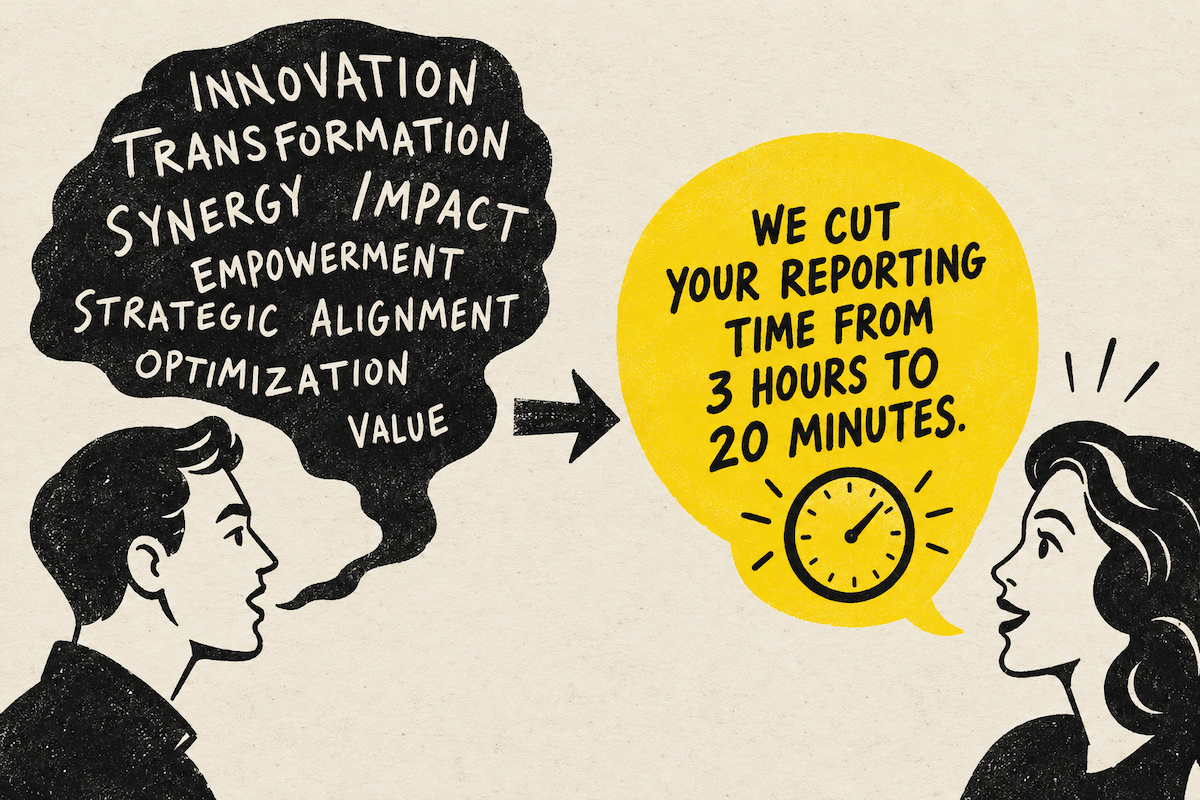
Welcome to the land of blah blah
“We deliver innovative solutions that improve organizational efficiency.”
Sounds professional. Says almost nothing.
But what does it really say?
Now try: “We cut your weekly reporting job from three hours to twenty minutes.”
Same basic promise. Completely different picture.
You know the old saying, the devil is in the details. At Noblahblah, we prefer a different version.
The delight is in the details.
Where the name comes from
The Concreteness Effect comes from Canadian psychologist Allan Paivio, who studied it in the 1960s.
Paivio found that concrete words like “tree” or “hammer” are remembered far better than abstract words like “justice” or “efficiency.”
His explanation, known as dual-coding theory, is that concrete words get processed twice. Once as language, and once as a mental picture. Abstract words only get the first pass.
That double processing is why concrete language sticks.
Why specificity works
Grant Packard and Jonah Berger tested this in the real world. Across five studies, including over 1,000 real customer service conversations, customers were more satisfied and bought more when employees used concrete language.
Why? Specificity signals that you are actually listening.
“I will look into that” is fine.
“I will check if the grey shirt is still in your size” sounds like you heard the question.
Give your audience something to see
Abstract language makes people do the work. Concrete language does the work for them.
❌ “Our program improves collaboration.”
✔️ “Your team leaves the meeting knowing who does what by Friday.”
❌ “This solution increases efficiency.”
✔️ “Your finance team closes the month two days earlier.”
The camera test
Here is a quick check. Could a camera film what you just said?
“A culture of innovation.” No.
“Every employee gets one afternoon a month to test a new idea.” Yes.
If your audience could film it, point at it or picture it, you are getting concrete.
One number, not seventeen
Being concrete does not mean burying people in detail.
Choose one number, one action, one moment. Just enough to make the abstract idea real.
“The devil may be in the details. But at Noblahblah, the delight is.”
Next time you draft a pitch, hunt down the words that sound impressive but could mean almost anything. Find the one detail that makes it real.
That is where the delight lives.